
GLARE-FREE LIGHTING FOR SPORTS
FIELDS: HOW TO ACHIEVE VISUAL COMFORT
AND PERFORMANCE
In sports lighting, glare-free lighting is a very important factor to consider as glare is a structural flaw that directly affects performance, safety, and compliance. Poorly controlled light causes visual discomfort for players, spectators, and referees, while also reducing the quality of televised events.
For facility owners and operators, glare-free lighting has become a strategic requirement. It must deliver high illuminance levels while preserving visual comfort, energy efficiency, and long-term operational value.
This is where modern LED systems, combined with intelligent control such as dimming, enable a new, more sustainable approach to sports lighting.
PERFORMANCE, COMPLIANCE, AND VISUAL CONSTRAINTS IN SPORTS LIGHTING
Why glare is a important risk to consider in sports environments
Glare occurs when excessive luminance enters the field of vision, exceeding the eye’s ability to adapt. On sports fields, this leads to:
- Reduced visibility of the ball and player movements
- Slower reaction times and increased injury risk
- Discomfort and eye fatigue for spectators
- Lower image quality for broadcasting cameras
In short, lighting with reducing glare is essential to ensure fair play, safety, and audience satisfaction.
Regulatory and environmental pressure for glare-free lighting
Sports lighting projects must comply with:
- EN 12193 requirements for illuminance, uniformity, and glare rating (GR)
- Federation-specific guidelines for competition levels
- Energy efficiency and carbon reduction targets imposed by public authorities
Simply increasing light output is no longer acceptable. Performance must be achieved without glare.
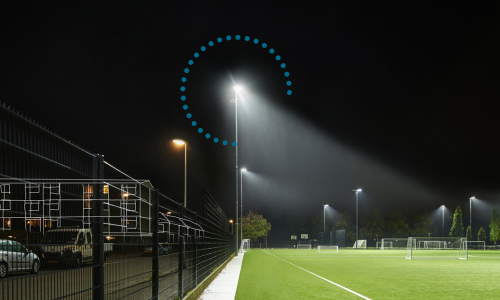
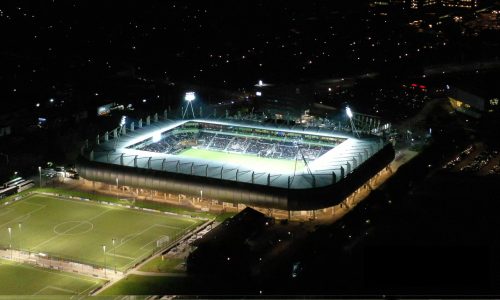
HOW TO ACHIEVE GLARE-FREE LIGHTING ON SPORTS FIELDS
1. Lighting design comes first
No-glare lighting starts at the design stage, not with the luminaire itself. Key principles include:
- Correct mast height and positioning
- Optimized aiming angles to avoid direct glare
- Balanced light distribution across the playing area
Photometric simulations are essential to predict glare levels before installation.
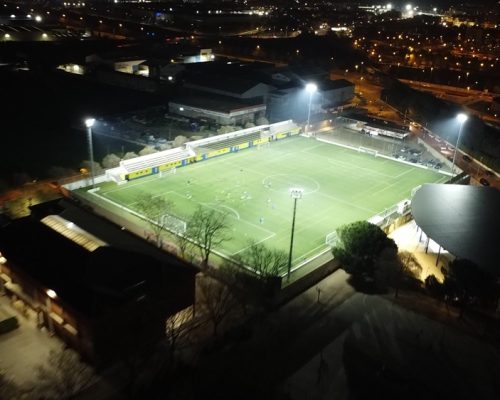
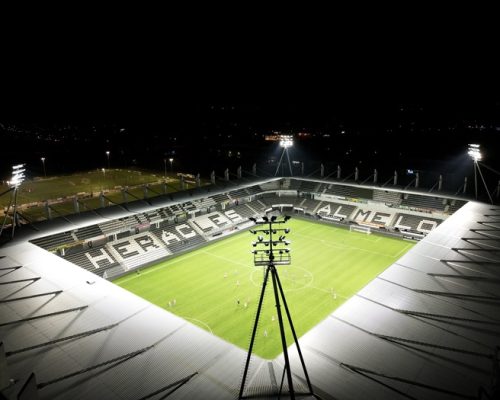
2. The role of LED optics
High-quality optical systems are central to glare-free lighting:
- Asymmetric beam distribution to direct light only where needed
- Cut-off optics to limit high-angle luminance
- Reduced spill light beyond the field
Poor optics are one of the main causes of glare, even in LED systems.
3. Intelligent light control and dimming for glare-free lighting
While not sufficient on its own, dimming LED lighting significantly supports reducing glare lighting by:
- Avoiding unnecessary overlighting during training or maintenance
- Reducing peak luminance levels
- Adapting light output to real usage scenarios
This approach improves visual comfort while delivering substantial energy savings.
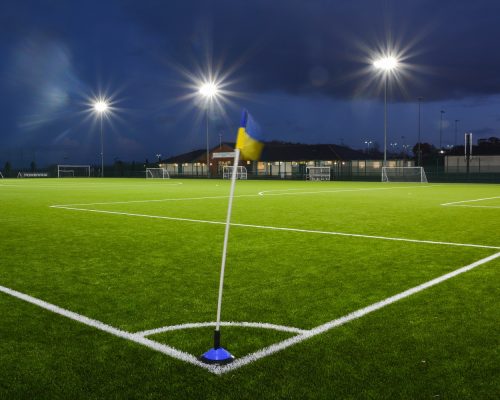
When choosing a no-glare lighting solution, it’s important to focus on visual comfort as well as performance. Key points to consider are proven glare ratings (GR), good optical control, flexible lighting modes for match, training, and standby, and stable light quality when dimmed, along with a reliable and future-proof system. Common mistakes include oversizing the installation, focusing only on high lux levels, using dimming only to save energy, and skipping real-life glare simulations, often leading to higher costs and lower user satisfaction.
THE BUSINESS BENEFITS OF A GLARE-FREE LIGHTING
Quantifiable results
Well-designed no-glare lighting systems typically deliver:
- 50–70% energy savings when combined with dimming strategies
- Glare ratings below GR 50, often below GR 40
- Longer luminaire lifespan due to reduced thermal stress
- Lower maintenance and operational costs
Strategic and reputational value
- Improved player performance and safety
- Better spectator experience and broadcast quality
- Easier compliance with evolving standards
- Strong sustainability and innovation positioning
Lighting with reducing glare is now an integral part of modern lighting strategies.
FAQ - GLARE-FREE LIGHTING FOR DECISION-MAKERS
Yes. With proper design, no-glare lighting meets top-tier competition standards while improving visual comfort.
No. Glare-free lighting focuses on controlling luminance and direction, not lowering performance.
Initial investment may be slightly higher, but lower energy consumption and maintenance costs significantly improve lifecycle ROI.
CONCLUSION
Lighting with glare reduction is the new standard for sports facilities. Achieving glare-free lighting on sports fields requires more than switching to LED technology. It demands a holistic lighting strategy combining optical precision, intelligent control, and rigorous design.
For professional decision-makers, glare-free lighting delivers measurable performance gains, regulatory confidence, and long-term sustainability.