TRAINING VS COMPETITION LIGHTING: HOW TO MANAGE SPORTS LIGHTING DIMMING INTELLIGENTLY
For sports clubs and municipalities, lighting is no longer just about visibility. It has become a strategic lever for cost control, sustainability, and operational flexibility. One of the most effective tools to achieve this is dimming LED lighting, especially when differentiating between training and competition scenarios.
Understanding how to manage lighting levels intelligently can significantly reduce energy consumption while maintaining performance and compliance.
Why training and competition lighting should not be the same
Training sessions and official competitions have very different lighting requirements:
Training: Focused on safety, comfort, and functionality
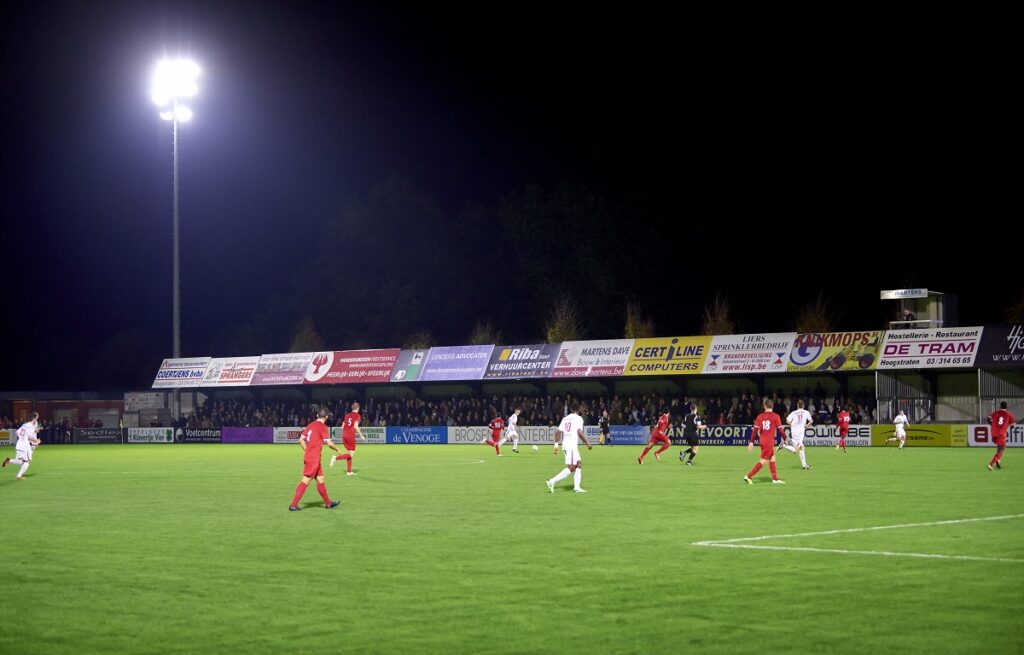
Competition: Driven by standards, visibility for players, officials, spectators, and broadcasting
Running sports facilities at full competition lighting for every training session leads to unnecessary energy use, higher operational costs, and increased CO₂ emissions.
This is where dimming LED lighting makes a measurable difference.
What is dimming LED lighting in sports facilities?
Dimming LED lighting allows operators to adjust light output dynamically depending on the activity, time, or user needs. Unlike traditional systems, LED luminaires maintain high efficiency and uniformity even at reduced power levels.
Key characteristics:
Precise control of light levels (e.g. 30%, 50%, 75%, 100%)
Instant response with no warm-up time
No impact on lamp lifespan
Consistent light quality across the field
For sport facilities, this flexibility translates directly into operational savings.
INTELLIGENT LIGHTING SCENARIOS FOR SPORTS FIELDS
Training Mode
Reduced lighting levels adapted to the sport and age group
Typical savings: 40–70% energy reduction
Lower glare and improved visual comfort for athletes
Extended luminaire lifetime
Competition Mode
Full compliance with federation or broadcast standards
Maximum uniformity and vertical illumination
Optimized spectator and camera visibility
With intelligent controls, switching between these modes is automated, not manual.
The role of smart controls and automation
True efficiency comes from combining dimming LED lighting with smart control systems:
Scheduled lighting profiles per field or pitch
Remote access for facility managers
Integration with booking systems
Real-time monitoring of energy consumption
Municipalities and clubs gain full visibility over lighting usage, enabling better planning and accountability.
Sustainability and policy alignment
Energy-efficient sports infrastructure is increasingly tied to:
Municipal climate objectives
Public funding requirements
ESG and sustainability reporting
By implementing dimming LED lighting, sports clubs can:
Reduce CO₂ emissions without compromising sports quality
Demonstrate responsible use of public budgets
Prepare facilities for future regulations
ROI: Beyond energy savings
While energy reduction is the most visible benefit, intelligent dimming also delivers:
Lower maintenance costs
Longer system lifetime
Reduced peak power demand
Higher facility availability
For large sports complexes or multi-site municipalities, the return on investment becomes particularly compelling.
CONCLUSION
The distinction between training and competition lighting is not a compromise, but an opportunity. By using dimmable LED lighting, sports facilities can combine performance, cost efficiency, and sustainability within one intelligent lighting approach. Smart lighting solutions have evolved beyond a simple technical upgrade and now play a strategic role in supporting long-term operational efficiency and quality.