
THE UNSEEN FACTOR: WHY LED COLOR QUALITY IS CRITICAL FOR SPORTS BROADCASTS (CRI vs. TLCI)
The switch to LED lighting has been revolutionary for sports venues, drastically cutting energy costs and maintenance. However, for any stadium hosting televised events, from local leagues to major international cup, the quality of light must satisfy standards far beyond what the human eye requires.
This is where technical terms like CRI (Color Rendering Index) and TLCI (Television Lighting Consistency Index) is important. Understanding these scores is the key to ensuring your audience enjoys a flawless picture at home and that your venue is broadcast-ready.
1. What is Color Rendering and why does it matter?
Good light must accurately reflect the colors of the playing field, the athletes’ jerseys, and sponsorship boards. This fidelity is measured using specialized indices.
CRI: The base standard for color
The CRI is the most common metric. It measures how faithfully a light source reveals colors compared to a perfect reference source (like daylight).
- For the spectator: CRI tells you what the live audience sees. A score of CRI 80 is typically the minimum requirement for general sports areas to ensure colors look natural.
- The problem: While a high CRI (e.g., 90) ensures great color for people, it fails to account for the unique way digital TV cameras process light. Cameras are sensitive to parts of the light spectrum that CRI doesn’t fully measure.
TLCI: The broadcast score
Developed specifically for broadcasters, the TLCI is the most accurate test of whether light is truly “TV-ready.”
- For the Camera: TLCI measures how closely the colors captured by the camera match the true colors of the scene.
- The Impact on Production: A high TLCI score (ideally 90) means the TV crew needs to perform little to no color correction in post-production, saving time and money. A low score forces costly, complex digital editing.
- Bottom Line: For any venue aiming for HD or 4K broadcasting, the TLCI is the score that counts the most.
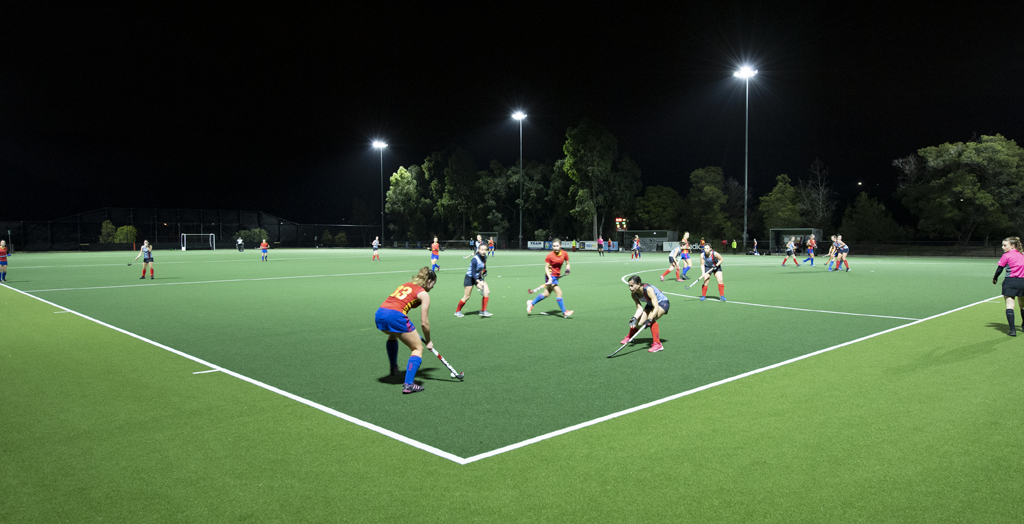
2. Technical requirements that guarantee a smooth broadcast
Beyond color quality, high-speed camera technology introduces two critical challenges that must be addressed by professional LED systems.
Eliminating flicker for
slow-motion replays
High-speed cameras, used for dramatic slow-motion replay, are extremely sensitive to the rapid on/off cycles of AC power.
- The Issue: If the LED drivers (the power supply units) are not high-quality, the resulting flicker is captured by the camera, even though it’s invisible to the human eye.
- The Broadcast: The replays will show distracting dark, horizontal bands rolling across the screen, making the footage unusable for professional broadcast.
- The Solution: Professional sports LED lighting systems must be certified as Flicker-Free (with a factor of modulation, or flicker percentage, of less than 2% or 3%).
Illuminance (Lux) and
Uniformity (U₀)
High-quality visuals require high levels of bright, even light across the entire playing surface.
- Illuminance (Lux Levels): Professional broadcasting demands high Lux levels (often 1500 to 2500 Lux for top-tier events). This brightness allows TV cameras to operate effectively, reducing digital noise and ensuring a sharp image.
- Uniformity (U₀): This ensures the light is spread evenly. A high uniformity ratio (U₀ ≥ 0,7 or 0.8 for broadcast) prevents harsh shadows and bright spots, which can be distracting and difficult for cameras to handle when panning across the field.
3. Strategic advantages of Broadcast-Grade LED lighting
Investing in high-specification LED lighting is a strategic move that affects the entire business model of a sports facility.
Future-Proofing your venue
As cameras advance (moving from HD to 4K and 8K), they become even more demanding regarding light quality. Installing lights that meet current TLCI 90+ standards ensures your facility is ready for the next decade of media technology.
Protecting brand and sponsorship value
Poor lighting leads to dull or inaccurately colored broadcast images. By ensuring true colors via high CRI/TLCI scores, you protect:
- The Visual Brand Identity of the teams and leagues.
- The Commercial Value of sponsors whose logos and ads must look vibrant and accurate on millions of screens worldwide.

Conclusion: When selecting LED lighting for a sports venue, the technical specifications—especially TLCI and Flicker-Free certification—are just as important as the energy savings. They are the gatekeepers to professional broadcasting and the true return on investment for any modern stadium upgrade.